
Reviewed · LAS VEGAS WALKING TOURS
Las Vegas Strip Self-Guided Walking Audio Tour
The most useful thing about this Las Vegas Strip audio tour is that it turns a long casino boulevard into a story you can follow. Instead of trying to read signs while dodging crowds, you walk from the Tropicana area with GPS-triggered narration guiding you toward more than 35 sights, from Leo the Lion to Mandalay Bay.
I like the offline maps, which matter in a place where phone service can be uneven inside huge resorts. I also like the freedom to stop for photos, shelter from rain, grab a drink, or wander into a casino without losing your place. The main drawback is sound: the Strip is loud, and one listener found the audio difficult to hear without reading the text aloud.
Key points to know before you walk
- More than four miles of Strip history: Allow one to two hours for the main route, with extra time if you stop at resorts or follow bonus stories.
- Automatic GPS narration: Audio stories begin as you reach each location, so you do not need to keep tapping your phone.
- A practical starting point: The tour begins at Tropicana Las Vegas and returns to the same meeting point.
- Useful offline access: Download the tour over strong Wi-Fi or cellular service before arriving.
- Good for independent sightseeing: Pause, skip, repeat, or restart the tour whenever you like.
- Check the price wording: The listed price is $14.99 per person, while the tour information also says it can be purchased per car, so confirm the booking terms before paying.
Walking Las Vegas through its resort-sized stories
Las Vegas is easy to see badly. You can walk for hours, take in a blur of towers and casino signs, and still miss why the resorts look the way they do. This audio tour gives you a thread to follow across the Strip, explaining the stories behind the oversized architecture, old casino names, celebrity connections, and strange bits of local history.
The route covers the main resort corridor rather than a small cluster of sights. It begins near the former Tropicana site, follows the Strip past MGM Grand and the central resorts, and continues toward Excalibur, Luxor, and Mandalay Bay before returning to the starting point.
You are not joining a group, and no guide meets you at the Tropicana. You open the Action Tour Guide app, enter the password sent by email and text, go to the first story point, and let the narration begin. From there, GPS cues direct you from one stop to the next.
That setup suits Las Vegas well. The Strip is too large and busy for a rigid walking schedule. You may want to pause at a fountain, step into a resort, find shade, or wait for a traffic signal. The app lets you do that without holding up anyone else.
More ways to see the Strip:
- Las Vegas Strip: The High Roller at The LINQ Ticket
★ 4.6 · 4,266 reviews - Las Vegas: The Strip’s Celebrity Chefs Tour or Downtown Food Tour
★ 5.0 · 1,704 reviews - Las Vegas: Night Helicopter Flight over Las Vegas Strip
★ 4.6 · 1,566 reviews
From Leo the Lion to the MGM Grand
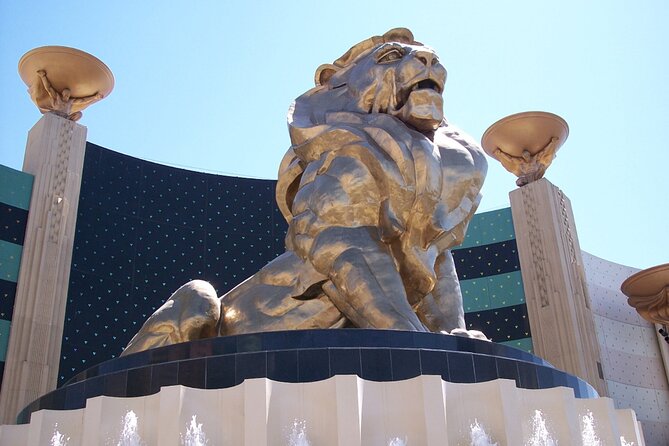
The first stop is Leo the Lion, the enormous golden MGM Grand sculpture. At 45 feet tall and weighing about 50 tons, it makes a strong opening sight.
The audio connects this statue to the real Leo the Lion from the Metro-Goldwyn-Mayer film logo. Leo roared before MGM films from 1957 through 2021, while the newer logo uses computer-generated imagery modeled on the same familiar animal.
This is a good example of the tour’s approach. You get a quick fact tied to something visible right in front of you, then a bit of film and resort history that gives the object more meaning. You do not need to enter the MGM Grand to understand the stop, though the casino and hotel are right beside the route.
The MGM Grand itself gets a useful dose of scale. Its current location opened in 1993, during a major period of construction on the Strip, and its hotel has 6,852 rooms. That number helps explain why Las Vegas resorts feel less like hotels and more like small districts with casinos attached.
The Strip is not technically in Las Vegas
One of the tour’s early facts is also one of the easiest to miss. The Strip is not technically inside the city of Las Vegas. It lies in Paradise, an unincorporated town that remained outside formal city government until 1950.
That detail gives you a better sense of the area’s identity. People use Las Vegas as a broad label, but the resort corridor has its own civic and commercial story. The audio does not treat the Strip as a single historic place. It shows how separate casinos and resort companies built a famous destination along one road.
The route is more than four miles long. The stated listening time is one to two hours, but your actual outing can take longer if you stop for photos, food, resort interiors, or extra audio. That flexibility is a strength, though anyone expecting a short stroll should know the distance adds up.
Planet Hollywood, Paris, and Horseshoe
Planet Hollywood Resort and Casino gives the tour a chance to explain how quickly the Strip changes. The current resort has operated since 2007, while the site previously held the Aladdin, which ran from 1966 to 1997.
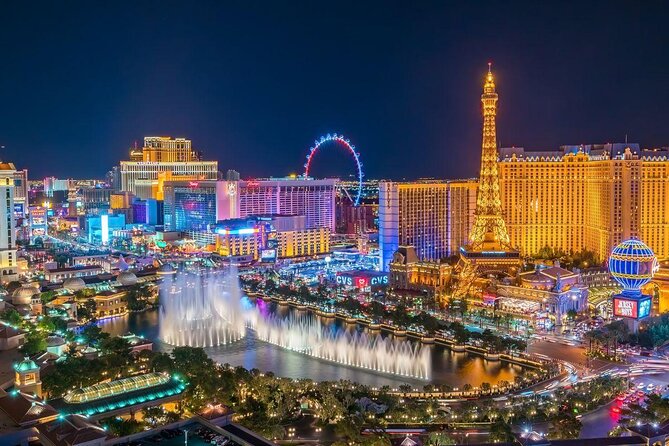
Next comes Paris Las Vegas, one of the clearest examples of the Strip’s habit of borrowing famous places from around the world. You will see replicas of the Eiffel Tower and Arc de Triomphe, along with a facade drawing on the Louvre, Musée d’Orsay, and Paris Opera House.
Paris opened in 1999, with development linked to French cinema figure Catherine Deneuve. The story helps you look past the replica buildings and think about the resort as a carefully built fantasy. Las Vegas does not simply copy a landmark. It compresses a whole city into a casino facade and invites you to treat the result as a postcard you can walk through.
Horseshoe Las Vegas opened in 2023 on the former Bally’s site, which had earlier been occupied by the old MGM Grand. Its name reaches back to Binion’s Horseshoe on Fremont Street, the casino tied to Benny Binion and the area once called Glitter Gulch.
This stop shows why an audio tour can be more useful than a quick online search. Resort names change, buildings get remodeled, and the same plot of land can carry several identities. The narration helps connect those layers as you move along.
More walking tours in Las Vegas:
- Las Vegas Downtown & Fremont Street – Guided Walking Tour
★ 5.0 · 636 reviews - Must-See Spots Vegas Strip Walking Tour
★ 5.0 · 384 reviews - Arts District Eats: Food, Art & Culture Walking Tour in Las Vegas
★ 5.0 · 191 reviews - Las Vegas: Fremont Street Walking Tour
★ 4.9 · 153 reviews
Flamingo, Harrah’s, and the old Strip
The Flamingo Hotel and Casino is one of the most important stops for understanding classic Las Vegas. It opened in 1946 and is the oldest continuously operating resort on the Strip.
Its Art Deco look drew on Miami Beach, while its service style pushed Las Vegas toward the high-end resort model. Fine dining, plush rooms, famous performers, constant gambling, and formally dressed dealers helped turn the Strip into more than a row of roadside casinos.
The Flamingo also reflects the influence of organized crime and celebrity culture in early Las Vegas, though the supplied audio details focus on its role as a model for later resorts. You can look at the property with a sharper eye after hearing how much the modern Strip borrowed from it.
Harrah’s has occupied its current position since 1992. Before that, the site held the Holiday Inn and Casino, one of the few casinos on the Strip operated by a woman for a significant period.
These stories are brief, but they give you a useful habit: pay attention to what stood on the site before the building in front of you. Las Vegas changes quickly, yet old names and old plots keep resurfacing.
Venetian, Mirage, Caesars Palace, and Bellagio
The Venetian occupies the former site of the Sands, once a favorite haunt of Frank Sinatra and the Rat Pack. The stop links the giant Venetian resort to the entertainment culture that made mid-century Las Vegas famous.
The Mirage then shifts the story toward modern resort development. It opened in 1989 and helped point the Strip toward the era of huge themed properties. The financing story is unusually specific: Michael Milken provided $525 million in bonds for construction, then faced indictment on racketeering and securities fraud charges eight months before opening. Steve Wynn still credited Milken with helping make the resort possible.
That is the kind of detail that adds bite to a walk dominated by polished facades. The Strip may look clean and theatrical, but its development involved risky financing, changing ownership, and large personalities.
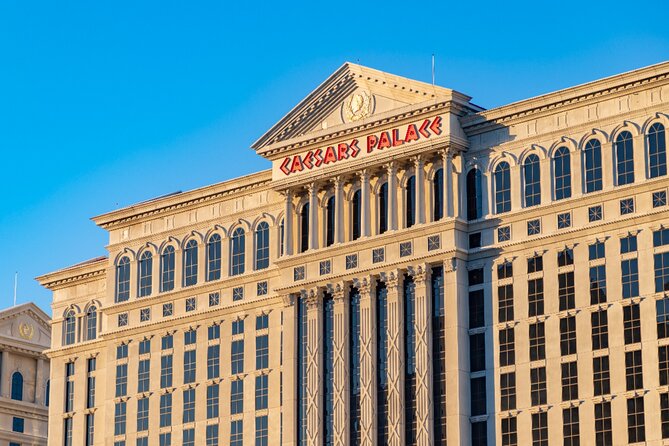
Caesars Palace opened in 1966. The audio connects its launch to Jimmy Hoffa, the Teamsters president who helped fund construction. This gives you a glimpse of the powerful business and labor relationships behind the resort boom.
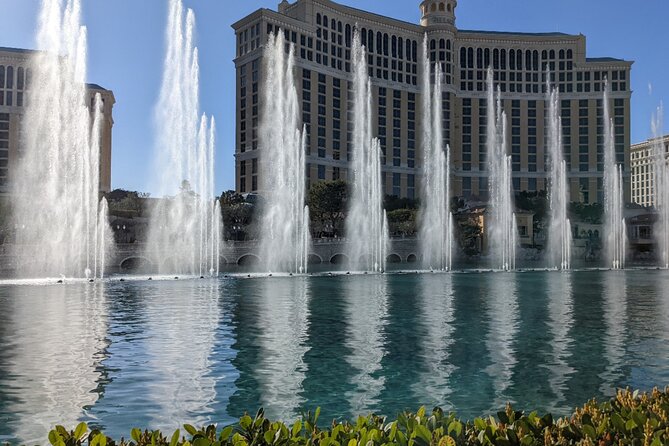
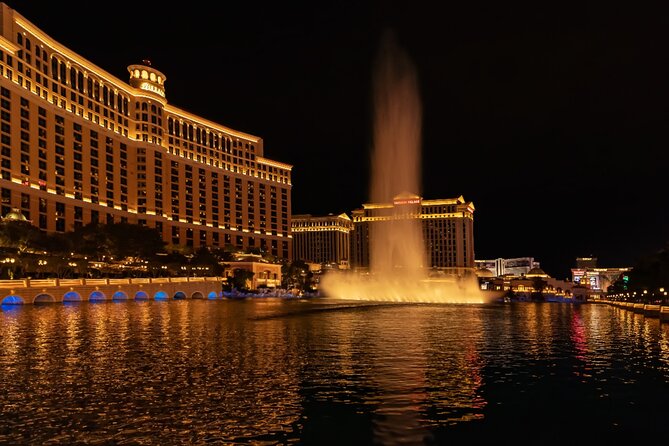
Bellagio opened in 1998 and takes its name from the village on Lake Como in northern Italy. Before that design was settled, Steve Wynn considered a 50-acre lake with an island holding a French-Alpine resort called Beau Rivage. A visit to Lake Como changed the direction of the project.
Even if you do not enter Bellagio, its location makes it one of the Strip’s most recognizable visual stops. The story helps explain why the resort feels less like a simple casino and more like a carefully staged European retreat.
ARIA, CityCenter, and Park MGM
ARIA opened in 2009 with a focus on technology. Its rooms were designed to respond when guests enter, adjusting curtains, lights, television, music, and climate controls. When guests leave, the systems shut down to save power.
That story contrasts nicely with the Strip’s older resorts. Las Vegas often sells nostalgia, but ARIA shows the city trying to present itself as efficient, modern, and high-tech.
The surrounding CityCenter, also called the ARIA Campus, includes ARIA, Waldorf Astoria, Vdara, Veer Towers, Crystals, and a large shopping complex. This is less a single attraction than a major resort district, so the audio is helpful for sorting out what you are seeing.
The Waldorf Astoria stop makes a playful distinction between the Las Vegas property and the famous New York hotel. The New York Waldorf Astoria has a long connection to powerful and notorious figures, including Frank Costello and Cuban dictator Fulgencio Batista. That comparison places the Vegas resort within a larger hotel brand story without requiring a separate museum visit.
Park MGM is the only totally smoke-free casino on the Strip. For some people, that fact alone makes the property worth knowing about. The tour also uses Park MGM as a moment to look back at older Las Vegas, a useful change of pace after the sleek CityCenter buildings.
New York-New York, Excalibur, and Luxor
New York-New York opened in 1997 and piles up replicas of Manhattan landmarks along its facade. The audio identifies the buildings, including the Empire State Building, Chrysler Building, Seagram Building, Lever House, and Brooklyn Bridge.
The resort continues the theme indoors and around the casino, with fiberglass versions of the New York Public Library, Statue of Liberty, Grand Central Terminal, and other recognizable structures. It is deliberately exaggerated, but that is the point. The property turns New York into a compact stage set.
The tour also explains a stamp scandal connected to the Statue of Liberty replica in 2010. This is a useful reminder that even a decoration can create legal and commercial trouble in Las Vegas.
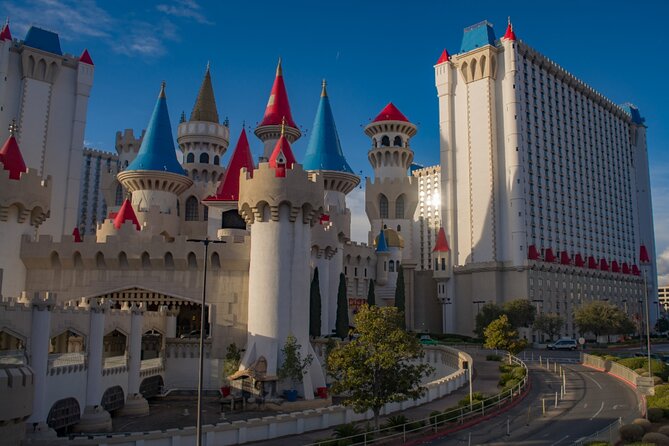
Excalibur comes next, with its cartoon castle facade and King Arthur theme. Rumors about its future have circulated for years, but the audio presents the building as still firmly part of the Strip. You can decide for yourself how well this medieval fantasy has aged beside the newer resorts.
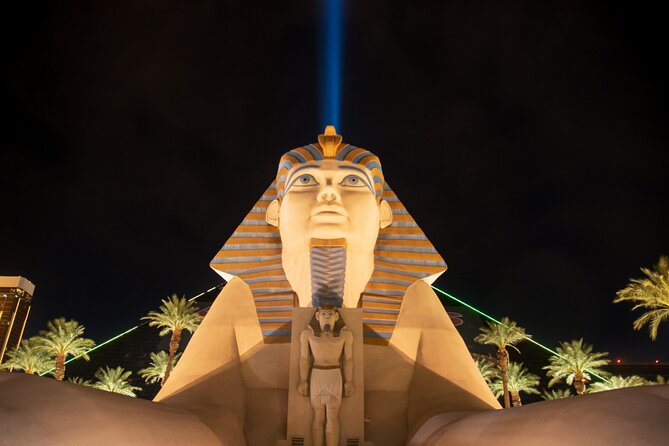
Luxor opened in 1993 and takes its name from the ancient Egyptian city. Its pyramid shape once made it one of the Strip’s biggest visual attractions. The Luxor Sky Beam, shooting upward from the pyramid’s peak, can be seen from across the Las Vegas Valley.
This section is especially good for anyone who wants to understand the Strip’s old love of themed architecture. Paris, New York, Egypt, medieval England, and ancient Rome all appear within a few miles.
Mandalay Bay and the final stretch
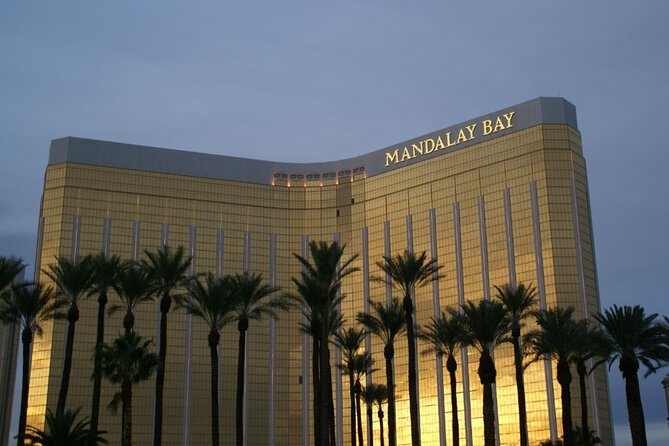
The route ends near Mandalay Bay, which opened in 1999. Early planning used the name Project Paradise, and the owners tested many alternatives before choosing Mandalay Bay.
The name refers to Mandalay, the second-largest city in Myanmar, located on the Irrawaddy River. The question of why a place called Mandalay Bay sits far from the nearest bay makes a fitting final story for a tour built around imagined destinations.
Mandalay Bay also helps mark the southern end of the resort corridor covered by the walk. At this point, you have seen how the Strip borrows from film, Europe, New York, Egypt, medieval legend, and Southeast Asia, then packages those references as competing resort brands.
The audio returns you to the meeting point at the Tropicana. Since this is GPS-based rather than guide-led, the route depends on following the app’s cues and keeping a reasonable walking speed. If you stop for a long meal or explore a resort, pause the tour rather than letting the narration run ahead.
How the app works in real conditions
After booking, you receive setup instructions and a password by email and text. Search your messages for audio tour, download the separate Action Tour Guide app, and load the tour while you have strong Wi-Fi or cellular service.
Use a phone with GPS. An iPhone running iOS 15 or later, an Android device running version 9 or later, or an iPad or tablet with GPS and cellular connectivity is recommended.
Bring earbuds or headphones. This is more than a comfort tip. The Strip has traffic, music, casino entrances, crowds, and wind, so a small speaker may be hard to hear. One listener found the sound difficult and read the text aloud instead. That workaround is possible, but headphones should give you a better chance of catching the narration.
The app plays stories automatically when you reach the right location. You can pause, skip, repeat, or use extra stories for places that interest you. The tour has lifetime access with no expiry, so you can use it again on another Las Vegas visit.
Price, timing, and who gets the best value
The stated price is $14.99 per person, which is modest compared with a bus tour or private guide. You are paying for the route, app access, narration, maps, and the freedom to set your own pace. You are not paying for meals, attraction admission, hotel entry, or a person walking beside you.
There is an important pricing inconsistency in the supplied details. One section lists the cost per person, while another says the tour is purchased per car and can be shared by couples splitting headphones. Check the final booking screen carefully so you know whether the charge covers each person or each group.
The tour is strongest for independent visitors who like context but dislike fixed schedules. It also suits repeat visitors who want to connect the resorts rather than spend the day inside one casino.
It is less suitable if you want a quiet listening environment, a guide who can answer questions, or detailed interior tours of every property. The audio points out and explains the resorts, but admission, food, and personal exploration are separate.
Free cancellation is available until 24 hours before the start time. Changes or cancellations inside that window are not refunded.
Should you book the Las Vegas Strip audio tour?
Book it if you want a low-cost way to make sense of the Strip while keeping control of your day. The best features are the automatic narration, offline maps, lifetime access, and the strong run of recognizable stops from Leo the Lion through Mandalay Bay.
Skip it if you already know the Strip well, prefer a live guide, or expect secret back corridors and extensive inside access. The stories are informative, but the route still depends on your phone, your headphones, and your willingness to walk more than four miles.
For most first-time visitors, I would download it before setting out, start early or late in the day, bring water and headphones, and leave room for unplanned stops. The Strip is more interesting when you know why its giant buildings look the way they do, and this tour gives you that background without tying you to a group.
FAQ
Where does the Las Vegas Strip audio tour start?
It starts at Tropicana Las Vegas, a DoubleTree by Hilton Hotel, at 3801 Las Vegas Boulevard South.
Where does the tour end?
The activity ends back at the starting meeting point.
How long does the walking tour take?
The main tour takes about one to two hours, though you may need extra time for breaks, photos, resort visits, or side trips.
How far is the route?
The walking route is more than four miles long and includes more than 35 audio stories.
Is a guide present at the meeting point?
No. This is a self-guided activity. You go to the first story point, open the Action Tour Guide app, and begin on your own.
Does the tour work without phone data?
Yes, if you download the tour and maps before starting. You must download the content while connected to strong Wi-Fi or cellular service.
What device do I need?
An iPhone running iOS 15 or later, an Android device running version 9 or later, or an iPad or tablet with GPS and cellular connectivity is recommended.
Is food included?
No. Food and drinks are not included.
How long do I have access to the tour?
The tour provides lifetime access with no expiry. You can use it on any trip and repeat it as often as you like.
More Self-Guided Tours in Las Vegas
- Red Rock Canyon Self-Guided Electric Bike Tour
★ 5.0 · 783 reviews - Self-Guided Fear and Loathing ATV Rental
★ 5.0 · 434 reviews - Self-Guided Fear and Loathing UTV Rental
★ 5.0 · 342 reviews - Las Vegas: Self-Guided ATV or UTV Rental
★ 4.8 · 152 reviews
Newly reviewed around Las Vegas
- Airport Transfer Private Luxury SUV Service★ 4.5 · 22 reviews
- Sandbox -Shooting Range Package★ 5.0 · 11 reviews
- Red Rock Canyon Talking GoCar Adventure — Fun, Self-Drive Tour★ 5.0 · 134 reviews
- RuPaul’s Drag Race LIVE! at the Flamingo Las Vegas★ 4.0 · 121 reviews
- Small Group Hoover Dam, Powerplant & O’Callahan Bridge Tour★ 5.0 · 17 reviews
- Sunrise Red Rock Canyon Self-Guided Electric Bike Tour with Hotel Pick-up★ 5.0 · 25 reviews
- Scorpions – Coming Home to Las Vegas: 60 Years of The Scorpions★ 4.5 · 6 reviews
- Private Transfer to Las Vegas Airport (LAS)★ 4.0 · 4 reviews
Las Vegas Walking Tours, compared.
Las Vegas Downtown & Fremont Street – Guided Walking Tour
Read our review →

Arts District Eats: Food, Art & Culture Walking Tour in Las Vegas
Read our review →


Original Las Vegas: The Fremont Street Experience Walking Tour
Read our review →
2-Hour Vegas Strip Walking Tour with Photos,Champagne & Vintage Vegas Goody Bags
Read our review →Browse the lists this tour appears in